Automation, Control & Monitoring Systems
Inspection, diagnostics, calibration, and troubleshooting for shipboard PLCs, AMS, PMS, and critical sensor networks.
Modern vessel operation relies on tightly integrated automation and monitoring loops. ME Group delivers field-level automation engineering, troubleshooting Programmable Logic Controllers (PLCs), Alarm and Monitoring Systems (AMS), Power Management Systems (PMS), and instrumentation loops to maintain safe automated watchkeeping.
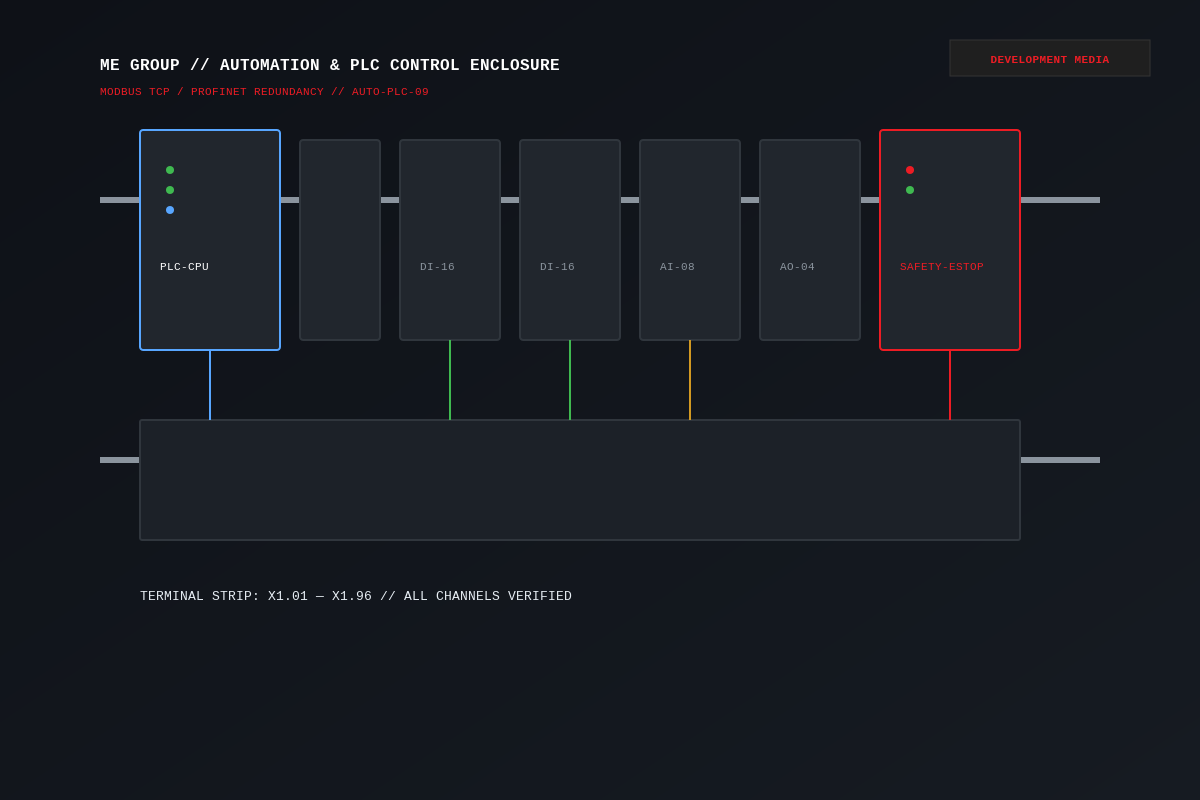
Automation troubleshooting requires deep signal-path clarity: distinguishing between physical sensor failure, loop wiring noise, controller logic errors, and downstream actuator faults. We resolve the root cause across the complete control chain.
ENGINEERING DELIVERABLES & INTERVENTIONS
Marine PLC Systems & Control Panels
Hardware diagnostics, I/O module testing, and control cabinet integrity.
- Marine PLC rack power supply, CPU status, and communication module inspection
- Digital and analogue I/O channel testing (4-20mA, 0-10V, PT100/RTD)
- Control cabinet wiring inspection, terminal tightening, and shielding verification
- Safety shutdown loop testing and emergency stop circuit verification
Alarm & Monitoring Systems (AMS)
Engine-room alarm monitoring, centralized workstation displays, and remote annunciators.
- Engine-room Alarm Monitoring System (AMS) channel diagnostics and fault clearing
- Exhaust gas temperature deviation monitoring and alarm threshold verification
- Bilge high-level alarm loop testing and sensor inspection
- Main bearing temperature alarm and oil mist detector interface checks
Power Management Systems (PMS) & Synchronization
Automated generator control, auto-synchronization, and load management.
- Auto-synchronizing unit testing and phase angle matching checks
- Automatic load-dependent start/stop sequence troubleshooting
- Non-essential load trip (preferential trip) system verification
- Symmetric and asymmetric load sharing controller calibration
Instrumentation & Marine Sensors
Sensors, transmitters, switches, and safety detection arrays.
- Temperature sensors (PT100, thermocouples) testing and loop resistance checks
- Pressure transmitters (fuel, oil, starting air, cooling water) zero/span checks
- Tank level transmitters (radar, hydrostatic, ultrasonic) signal verification
- Engine-room fire alarm detection loops and flammable/toxic gas detectors
CONFIRMED EQUIPMENT HANDLED
Technical scope supported across Automation & Control.
Programmable Logic Controllers (PLC)
Alarm & Monitoring Systems (AMS)
Power Management Systems (PMS)
Auto-Synchronization Units
PT100 RTDs & Thermocouples
4-20mA Pressure Transmitters
Hydrostatic Tank Level Transmitters
Marine Fire & Gas Detection Panels
HOW WE EXECUTE & VERIFY
Standardized operational methodology applied during Automation & Control interventions.
Signal Path & Fault Trace
Checking diagnostic buffer logs on PLCs/AMS panels and tracing signal loops from field transmitter to controller I/O.
Hardware & Sensor Testing
Testing sensor outputs, signal loops, and transmitter responses across temperature and pressure measurement points.
Logic & Interface Verification
Verifying trip setpoints, alarm delays, interlock states, and communication bus integrity (Modbus/CAN/serial).
Full Loop Simulation & Handover
Simulating operational fault states to confirm correct alarm annunciation, automated corrective action, and safe shutdown.
TYPICAL FAULT SCENARIOS WE RESOLVE
Practical operational symptoms encountered onboard and our technical response path.
False exhaust temperature deviation alarm locking out automation
Measure loop millivolt values, test sensor junction boxes, replace degraded thermocouple element.
Generators fail to auto-synchronize during parallel connection attempt
Verify voltage/frequency matching signals, test speed governor actuator signal from PMS.
Engine-room fire alarm loop reports open-circuit fault in zone
Locate broken wiring in loop, verify end-of-line resistor values, test individual detector bases.
HOW AUTOMATION & CONTROL CONNECTS ACROSS THE VESSEL
Shipboard faults do not operate in silos. ME Group engineers cross-examine adjacent systems to resolve root causes.
Electrical Power & Distribution
PMS logic directly controls switchboard breaker trips, bus-tie closings, and generator excitation commands.
Pneumatic Systems & Control
Automation outputs drive solenoid valves and positioners on pneumatic safety and control manifolds.
Mechanical Engineering
Sensors protect prime movers, detecting high jacket water temperature, low lube oil pressure, and abnormal RPM.
Radio & Bridge Systems
Bridge navigation interfaces with central Alarm Monitoring Systems (AMS), BNWAS alert loops, and Voyage Data Recorders.
REQUIRE TECHNICAL SUPPORT FOR AUTOMATION & CONTROL?
Submit your vessel details, observed equipment parameters, and port schedule. Our marine engineering triage team reviews the technical scope immediately.